

The Light of the Body is the Eye
The light of the body is the eye: therefore when thine eye is single, thy whole body also is full of light; but when thine eye is evil, thy body also is full of darkness.
Take heed therefore that the light which is in thee be not darkness.
If thy whole body therefore be full of light, having no part dark, the whole shall be full of light, as when the bright shining of a candle doth give thee light.
— Luke 11:34–36 (KJV)
You think this is about vision.
It is about permission.”
”You live among them.
You sleep in what they build.
You eat what they carry.
You heal in what they clean.
You call this economy.
It is dependence
wearing a clean shirt.
— The Voice, The Lamp
A New Play in Verse
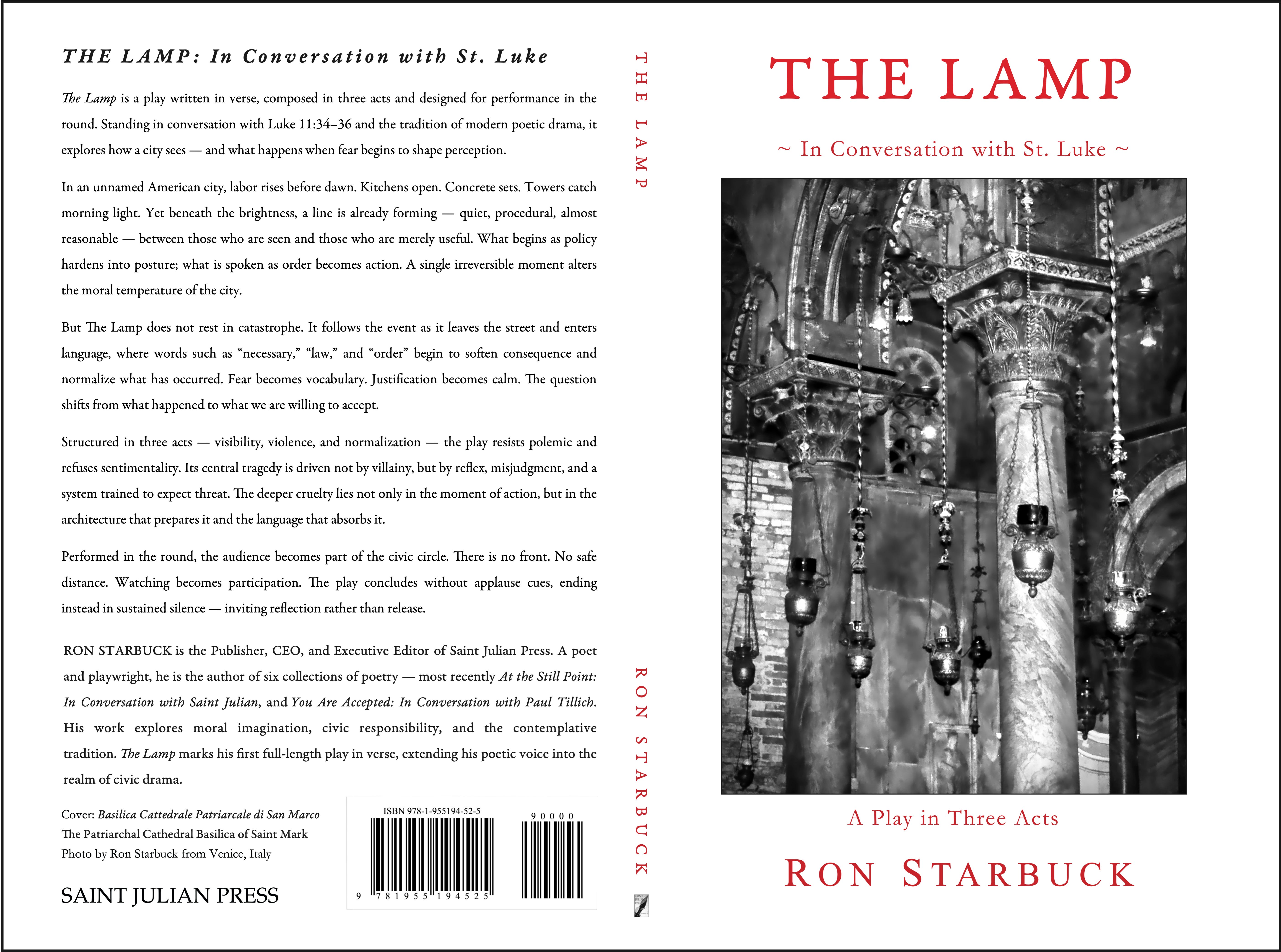
The Lamp: In Conversation with St. Luke
May 4, 2026
There are moments when a work arrives not as argument, but as witness.
The Lamp: In Conversation with St. Luke, a new three-act play in poetic verse by Ron Starbuck, has now been released by Saint Julian Press as a Dramatic Literature Edition—intended for reading, reflection, and shared use in congregational settings.
Framed as a civic lament, the play asks how we see—and what happens when fear begins to shape that seeing.
Drawing on the imagery of Luke 11:34–36, The Lamp centers on questions of moral clarity and conscience.
What the Play Holds
Set in an unnamed American city, the drama traces a movement:
from ordinary life
to a moment of irreversible consequence
and then into the language that follows
It is in that final movement—language—that something deeper is revealed.
Words such as “necessary,” “law,” and “order” begin to carry weight.
They begin to soften, or obscure, what has occurred.
The play unfolds in three movements:
Visibility. Violence. Normalization.
A Work Meant to Be Read Aloud
The Lamp is published as a Dramatic Literature Edition, not only for private reading, but for table readings in churches and community groups.
In a table reading, participants gather and read the roles aloud—no staging required. What emerges is not performance in the traditional sense, but a shared space:
for listening
for reflection
for conversation
The structure of the play—spoken text, intentional silence, and a central “Voice” of conscience—lends itself naturally to contemplative and liturgical settings.
An Invitation to Congregations
Saint Julian Press offers this work as a resource for Episcopal congregations and others seeking a way to engage contemporary immigration realities with care, depth, and moral attention.
This is not a program.
It is not a directive.
It is a text to be entered.
Availability
Discounted copies are available to churches for group use, with pricing set to cover printing and shipping costs.
To request copies for table readings or events:
SJP-Publisher@saintjulianpress.org
Individual copies are also available through:
Bookshop.org
Amazon
Barnes & Noble
A Closing Word
The Lamp: In Conversation with St. Luke is a civic lament in verse—exploring visibility, fear, and moral normalization in an American city.
Written for reading in the round, or in stillness, it asks a single question that does not easily resolve:
What happens when light gives way to justification?
About the Author
RON STARBUCK is Publisher, CEO, and Executive Editor of Saint Julian Press. A poet and playwright, he is the author of six collections of poetry, including:
There Is Something About Being an Episcopalian
When Angels Are Born
Wheels Turning Inward
A Pilgrimage of Churches
At the Still Point: In Conversation with Saint Julian
You Are Accepted: In Conversation with Paul Tillich
The Lamp: In Conversation with St. Luke is his first full-length play in verse. A second play, The Nearness of Light, is scheduled for release in July 2026. Saint Julian Press has published nearly 80 literary works by poets and writers.
Notes & Reflections
There is a difference between seeing and permitting.
Much of public life turns on that distinction. We learn to name what we see, but we also learn—quietly, gradually—what we are willing to allow to remain. Language becomes the instrument of that allowance. It does not always conceal; often, it reframes. It steadies. It explains. It makes the unbearable livable.
The play does not argue against order. It asks what kind of order we are forming, and at what cost. It does not deny fear. It asks how fear is being taught to speak—through policy, through repetition, through the words we come to trust.
A table reading places these questions in the room, not as positions to defend, but as lines to be spoken aloud. When heard in the voices of others, something shifts. The distance narrows. The language returns to breath.
And perhaps that is where the work begins—not in resolution, but in attention.
The line from the Gospel is not a warning given once. It is a condition revisited.
Take heed…
The play leaves that work unfinished.
Selected excerpts from the play are available on the Saint Julian Press website:
https://www.saintjulianpress.org/book-quotes-1