

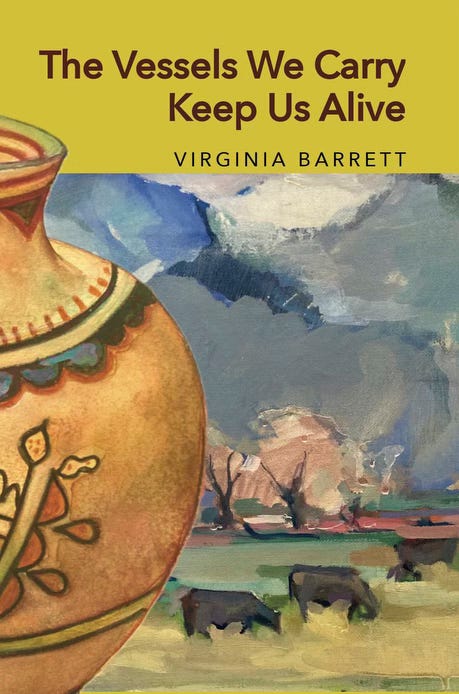
The Vessels We Carry Keep Us Alive
by Virginia Barrett
I. The Room Changes
Some poetry asks to be read. This book seeks to be entered.
The Vessels We Carry Keep Us Alive unfolds the way morning light moves across a wall—quietly, without announcement, until you realize the room has changed. Virginia Barrett does not rush the page. She lets wind speak first, then crow, then the small human ache that follows us into desert and chapel alike. What emerges is not a statement about the sacred, but an immersion in it.
From its opening movements—poems like “Sequestered” and “Collection Day”—Barrett situates us in a world where breath is both literal and sacramental. “The whole expression is breath,” she writes. In that single line, the book quietly reveals its theology. Breath becomes presence. Presence becomes prayer. What might otherwise be ordinary—a blue recycling bin, a garden in early light—begins to shimmer as a threshold.
II. Sacred Geography
The landscapes of Taos, Chimayó, and Ojo Caliente in New Mexico, followed by views along the Pacific coast, are not merely settings; they are participants.
In “Benediction—Chimayó,” sacred geography and human longing intertwine, the body thirsting alongside the land. In “Into the Woods,” listening itself becomes the poem, as though language rises from pine needles and meltwater rather than from the poet’s hand. These are poems that kneel without announcing that they kneel.
Barrett does not romanticize the landscape. She inhabits it. Desert rain is a blessing. Chapel dust is a sacrament. Even supermarket parking lots hold their circling crows as witnesses to mortality and memory. Nothing is outside the field of attention.
And attention, here, is reverence.
III. Grief as Vessel
What moves me most is Barrett’s refusal to separate grief from illumination.
In “Dream: Taos,” loss burns like a poppy in flame. In “Temporary Shelter,” fragility becomes a thin membrane vibrating between fear and song. The poems understand that vulnerability is not weakness but a container.
Ashes. Urns. Rivers. Bread. The body itself.
Each becomes a vessel.
In “The Urn of Our Knowing,” memory holds the body’s ashes beneath towering trees. Yet nothing is closed. Nothing sealed. The poems move toward openness—even when standing in sorrow. The vessel is not meant to imprison what it carries. It is meant to be returned.
IV. The Discipline of Attention
There is a contemplative patience throughout this collection—a steadiness that recalls desert spirituality and the long lineage of mystical listening. Yet Barrett’s voice is wholly her own.
She trusts stillness.
She allows silence to shape the line.
In “Into the Woods,” the forest floor “holds / hundreds of pine cones / waiting to seed,” and the final word is simply “Listening.” It is a fitting emblem for the book as a whole. The poems do not strain for transcendence; they discover it flickering in a crow’s wing, in bending grass, in the breath that steadies us at dusk.
This is a mature collection, carrying the quiet authority of a poet who has learned that revelation rarely arrives as thunder. It arrives as attention.
V. A Living Prayer
Reading The Vessels We Carry Keep Us Alive feels less like moving through pages and more like entering a cloister without walls. One steps inside and finds that the air has changed. The noise of the world does not disappear, but it is gathered, sifted, and offered back in another register.
The poems remind us:
To live well is to notice.
To notice is to love.
To love is to become, however briefly, a vessel strong enough to hold both sorrow and light.
And perhaps that is the quiet wisdom this book offers—that we are carried as much as we carry. That breath itself is a gift. That the room is always changing, if only we would stand still long enough to see it.
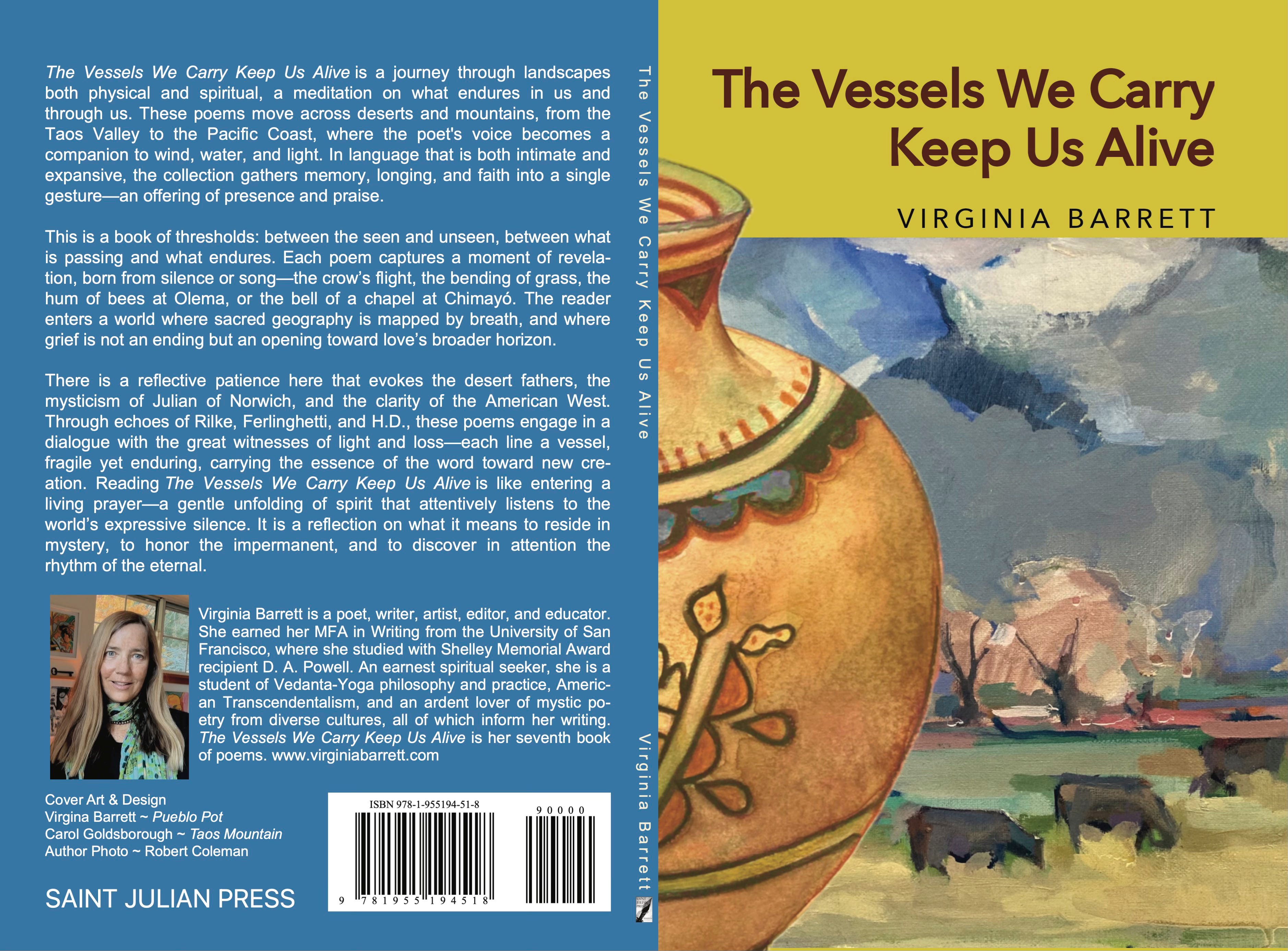
Virginia Barrett is a poet, writer, artist, editor, and educator. She earned her MFA in Writing from the University of San Francisco, where she studied with Shelley Memorial Award recipient D. A. Powell. An earnest spiritual seeker, she is a student of Vedanta-Yoga philosophy and practice, American Transcendentalism, and an ardent lover of mystic poetry from diverse cultures, all of which inform her writing. The Vessels We Carry Keep Us Alive is her seventh book of poems.
Publication Date: March 31, 2026
Paperback: $18.00
Publisher: Saint Julian Press, Inc.
Language: English
Paperback: 116 pages
ISBN-13: 978-1-955194-51-8
—Ron Starbuck, Publisher
Saint Julian Press, Inc.
Houston, Texas
Saint Julian Press ~ Press Release
Saint Julian Press - Bookshop.org Store
Saint Julian Press, Inc. © 2026