

In 1877, on the open sweep of the Kansas prairie, formerly enslaved families came west and founded Nicodemus, staking homesteads along the South Fork of the Solomon River and carving shelter from the very earth beneath their feet. They lived first in dugouts and sod houses, weathering wind, winter, and the long distances between hope and harvest, yet they built churches, a school, and a township hall—structures of wood and prayer rising from grass and clay. It remains the only surviving western town established by Black settlers after the Civil War, a living testament to the Exoduster journey: an American exodus toward land, citizenship, and dignity. During Black History Month, Nicodemus stands not merely as a historic site, but as a prairie witness—freedom patiently worked into the soil, born again in water and Spirit.
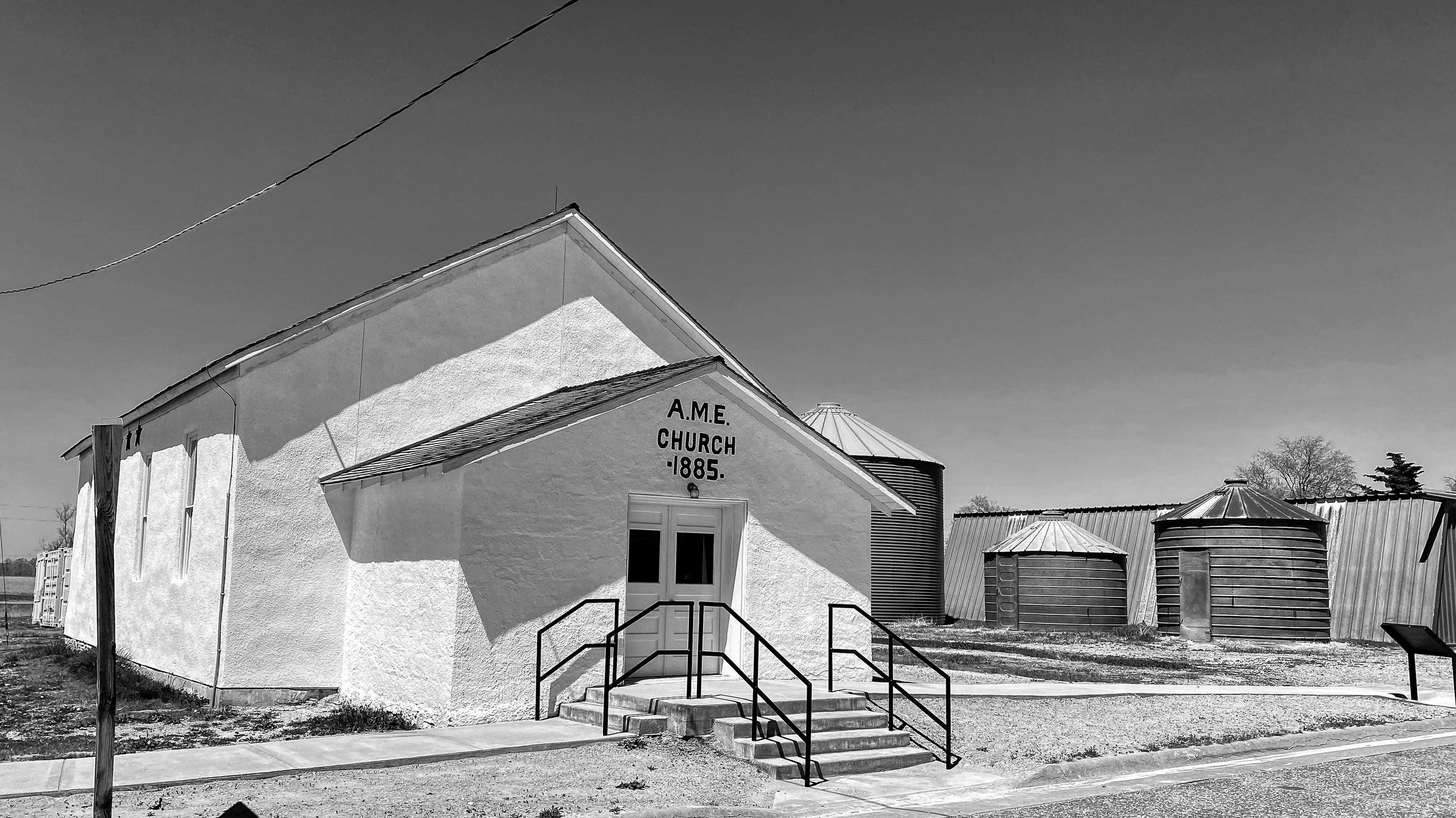
NICODEMUS RISES
JOHN 3 — (NRSV)
5 Jesus answered, “Very truly, I tell you, no one can enter the kingdom of God
without being born of water and Spirit. 6 What is born of the flesh is flesh,
and what is born of the Spirit is spirit.
Absalom Jones and Richard Allen
Ordained as Episcopal
And Methodist clergy
Could little imagine how one day
Nicodemus Kansas would rise
From the Great Plains of America
Among the Smoky Hills
Where wooded streams flow
Ceaselessly downward to the
South Fork Solomon River
Meandering along meadow and valley
Lush with green prairie grasslands
Amid chalk-colored hills airy-skies
Abundant wildlife — deer turkey quail
Pheasant and vibrant wildflowers
Wading in the troubled waters of Jordan
Where Moses led the Israelites
A new community of believers
Who sought a freedom
And society never known before
Refugees from Southern States
Newly coined as American citizens
Seeking the Promised Land
In fertile fields and countryside
In an exodus by the thousands
To claim acres and homesteads
Their story is an immigrant one
A story of how they endured
Dauntless and hope filled
With resilience and resistance
They took up residence alone
Among tentative neighbors
To create a new history
Standing together as one
People — finding a renewed
Unity and freedom in its name
As their children stood tall
And still stand high today
Far from Egypt’s land
Nicodemus ever rises
Born again and again
In water and Spirit
Nicodemus ~ National Historic Site ~ ~ Kansas ~ U.S. National Park Service
Bob Dole’s Role in Nicodemus Becoming a National Historic Site
Senator Dole played a key role in establishing Nicodemus as a National Historic Site under the National Park Service:
In the mid-1990s, Dole introduced legislation in Congress to designate Nicodemus as a protected historic site, working with local leaders and the National Park Service to safeguard the town’s historic structures.
This effort culminated in the town’s official designation as a National Historic Site on November 12, 1996, preserving its legacy for future generations.
Decades later, Nicodemus continues to commemorate and interpret this unique chapter in American history through park programming, community events, and collaborations that highlight its significance in the broader story of Black settlement and westward migration.
Historical Note
The African American settlers of Nicodemus lived within a regional climate marked by both pragmatic coexistence and racial exclusion. Early interactions with neighboring white communities often involved trade and the mutual dependencies common to frontier life, yet social equality remained limited and economic opportunity unevenly distributed. When railroad lines bypassed Nicodemus in favor of nearby white towns, capital and development followed those routes, deepening the town’s geographic and financial isolation.
By the late nineteenth and early twentieth centuries, many surrounding Kansas communities adopted informal or explicit “sundown” practices that discouraged or barred Black residents after dark. These restrictions were typically enforced not through organized violence but through intimidation, housing exclusion, and social pressure that reinforced racial boundaries. In such an environment, Nicodemus endured less because of regional acceptance than because of communal resilience, self-governance, and a determined commitment to sustain civic and spiritual life on its own terms.
Books From ~ Saint Julian Press
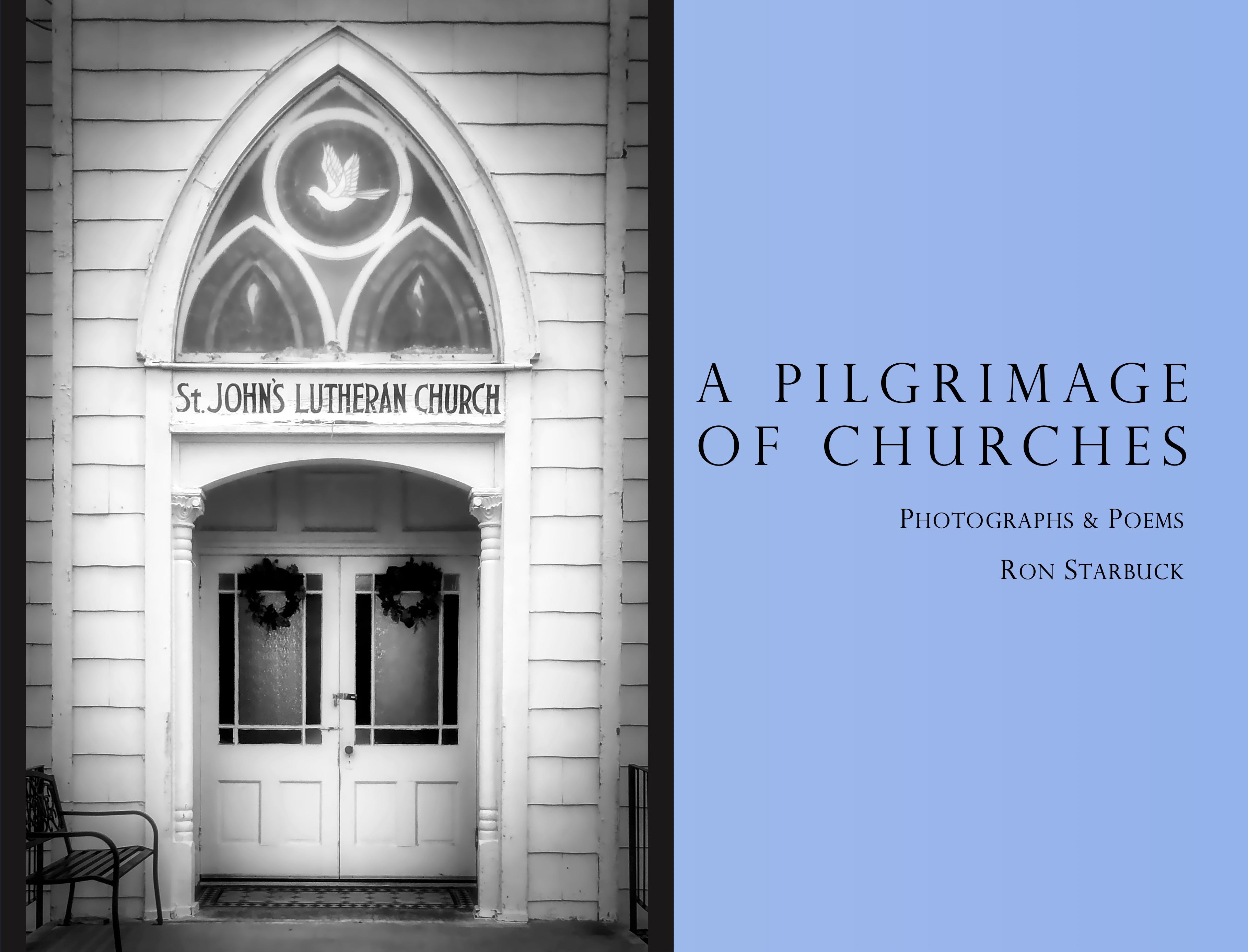
A Pilgrimage of Churches by Ron Starbuck
Apple Books ~ Enhanced eBook Edition
with High Resolution Photographs & Audio Recordings
A PILGRIMAGE OF CHURCHES will take the Reader on a powerful and transformative journey far into the heart of old and devotional America: to where the inspired and believing once established their vision of a true Jerusalem and of their Christ upon the coastal plains of Texas and up northward onto the plains of Kansas. This book is a gentle masterpiece of perception and human record, bringing back to life a world that has vanished from our Twenty-First Century culture. Like an ancient, illuminated manuscript this book will deliver lightness and conviction into your hands and eyes. Starbuck is a master of poetic tradition and diction, and his delivery of these prophetic songs – which vividly and precisely depict a forsaken time – returns us to those sacred grounds. About the author himself we can most certainly say that, ‘his aim is true’.
—Kevin McGrath
Harvard University
We all know the people of the Midwest have raised corn and crops forever, but they also raised churches, churches of many denominations, Methodist, Catholic, AME, Presbyterian, Lutheran, Baptist. On his midwestern and western pilgrimage, Ron Starbuck found both images and words that capture the holiness in both sacred and secular places in the middle of America.
In this collection, it almost feels as if Ron Starbuck has caught time sleeping as he delivers up images that seem pulled not just from the center of the country, but from the middle of the last century.
Time is stopped here and frozen, in the silvery light of these photographs, which alongside Ron Starbuck’s poems that read like Biblical passages “pour out a radiance, A great reverence” for these far-flung and spiritual places.
Whether he is photographing tiny chapels and small-town clapboard churches or parking lots of John Deere tractors or plowed fields and pastures, these black and white images and liturgical-sounding poems evoke the same stark America as the WPA teams. Ron Starbuck is Walker Evans and James Agee rolled into one here, a new documentarian for a forgotten era of divine places.
—Elizabeth Cohen
The Family on Beartown Road: A Memoir of Love and Courage
On Being American ~ Letters from Homer
Dear Family & Friends,
I’ve been sitting with Nicodemus Rises, and I want to tell you what it feels like from where I stand — boots in the dirt, hat in hand, looking out over a wide Kansas sky.
The poem opens with that midnight talk from John’s Gospel — “born of water and Spirit.” That’s not just church language floating above the page. It’s used like a plow. It cuts a furrow straight through American history.
What strikes me first is this: Nicodemus, Kansas, isn’t treated like a footnote. It’s treated like a resurrection.
You see how the poem draws a line from Absalom Jones and Richard Allen — two Black ministers who stepped forward in a young, unfinished America — all the way out across the prairie. Both of them — “could little imagine” that a town named Nicodemus would rise. That’s moral imagination at work. It reminds us that seeds are planted long before anyone sees a harvest.
Then the land begins to speak.
Smoky Hills. The South Fork of the Solomon River. Deer and quail. Chalk hills and wildflowers. This isn’t just scenery. The prairie becomes the Jordan. Kansas becomes Exodus ground.
That’s where the poem grows strong.
Moses stands quietly beside formerly enslaved Americans — not in a loud, preachy way. Just steady. “Refugees from Southern States / Newly coined as American citizens.” That phrase carries weight. “Newly coined.” Like a nation fresh from the mint, and these people testing its worth.
The poem calls their story an immigrant one.
That matters.
Because we forget. We talk about westward expansion as if it belonged only to wagons and railroads. But Black Americans were homesteaders too — claiming acres, building churches before sidewalks, raising families under a sky that didn’t promise anything. “Tentative neighbors.” That word does quiet and sincere work. It tells the truth without raising its voice.
At its heart, the poem says they were born again — not only in the spiritual sense, but in the civic one.
Citizens. Landowners. Community builders.
That’s John 3 lived out on the prairie.
And notice what happens at the end. The story isn’t sealed up in the 1870s. “Nicodemus ever rises / Born again and again / In water and Spirit.” The poem moves from history into prophecy.
Rebirth isn’t a one-time thing. Not for a soul. Not for a town. Not for a country.
What I admire most is the tone. There’s no bitterness here. The poem doesn’t deny “troubled waters.” It remembers Egypt. But it refuses to camp there. The hope isn’t naïve. It’s earned. It feels like endurance.
Even the lines rise. Short phrases. Vertical movement. The poem stands up slowly, like those children who “stood tall / And still stand high today.”
If I were to put it plain, this poem suggests America’s promise wasn’t completed in a single founding moment. It had to be claimed again — out on Kansas soil — by people who had every reason to doubt it and chose not to.
Water is crossing rivers.
Spirit believes the crossing means something.
The poem ties Scripture to soil without forcing either one. It lets the land preach.
And in days when folks argue about who belongs, this piece reminds us that the Promised Land in America has always been built by people arriving wounded, hopeful, and stubborn enough to plant anyway.
The prairie still has sermons in it.
— Homer
Publisher: Saint Julian Press, Inc.
Publish Date: November 05, 2021
Pages: 140
Language: English
Type: Paperback
EAN/UPC: 9781733023375
Dimensions: 8.5 X 11.0 X 0.4 inches | 1.0 pounds
BISAC Categories: Arts & Hobbies, Poetry, Poetry, Poetry


